Introduction: The Hidden Enemy of Automation
In the high-speed world of Industrial 4.0, precision is the primary currency. Whether it is a six-axis robotic arm performing micro-welding for a European car manufacturer or a collaborative robot (cobot) handling sensitive electronics in a North American facility, the expectation is the same: absolute repeatability. However, as factories become more "intelligent," they also become electrically noisier.
For the engineers and maintenance teams at Shenzhen Chuanshang Electronics, we have identified a recurring challenge in modern automation: Electromagnetic Interference (EMI). This "invisible enemy" can turn a high-performance robotic system into an unreliable liability. This article explores why shielded connectors are not just an option but a critical necessity for maintaining signal integrity and operational uptime in high-speed robotics.
1. The Physics of the Factory Floor: Understanding the Source of EMI
To understand why shielding matters, one must first look at the environment of a typical industrial plant. A robotic cell is surrounded by high-power motors, variable frequency drives, and heavy-duty switching gear. These devices generate powerful electromagnetic fields every time they start, stop, or change speed.
How Noise Becomes Data Errors
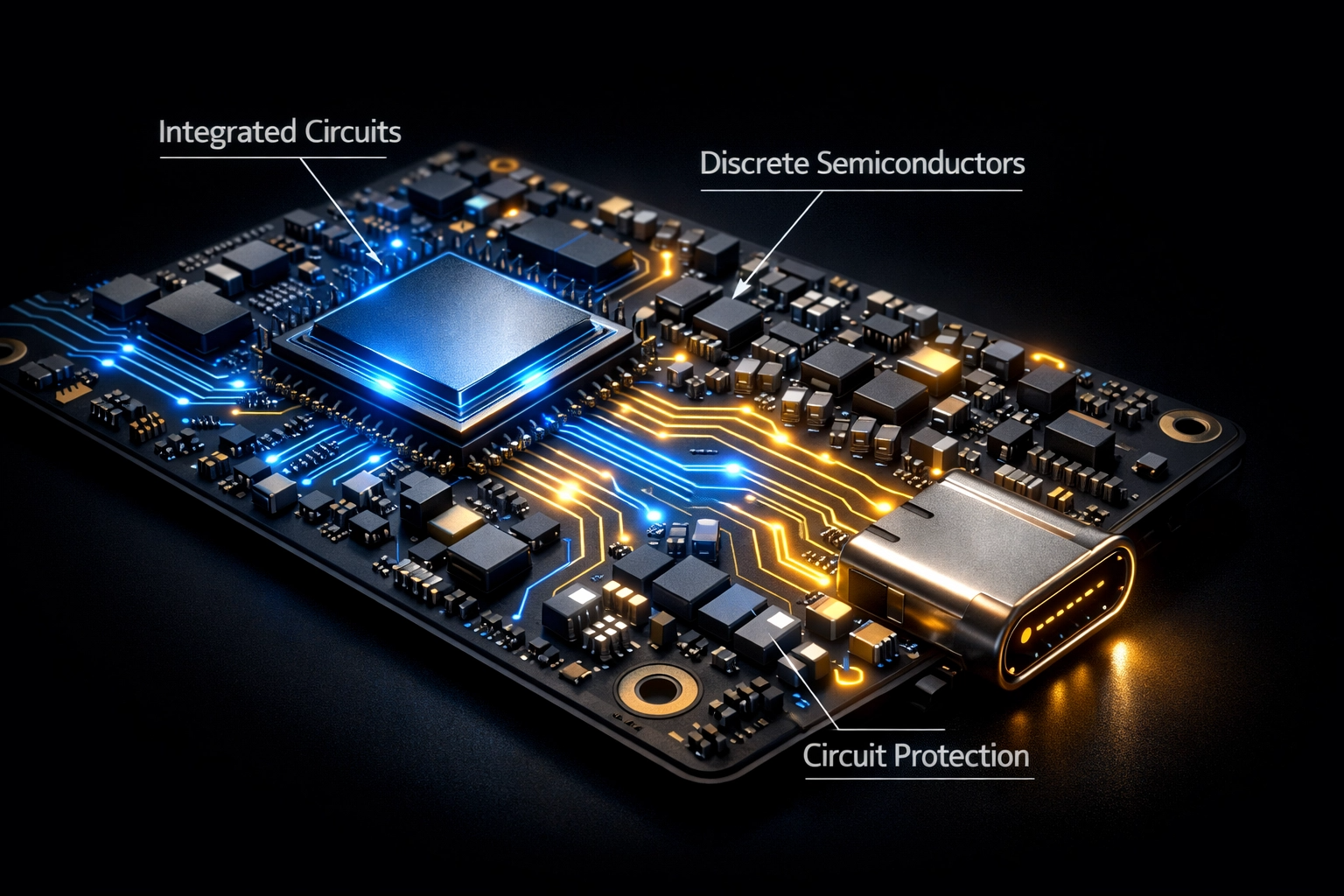
When an unshielded or poorly shielded cable runs near these power sources, it acts like an antenna. It picks up the electromagnetic noise and injects it into the low-voltage signal lines that carry data from Sensors to the Integrated Circuits (ICs) in the controller.
• Signal Distortion: In digital communication, this noise can "flip" a bit from a zero to a one.
• The Result: The robot receives a false command, leading to "jitter," positional errors, or an emergency stop triggered by a communication timeout.
2. Anatomy of a High-Performance Shielded Connector
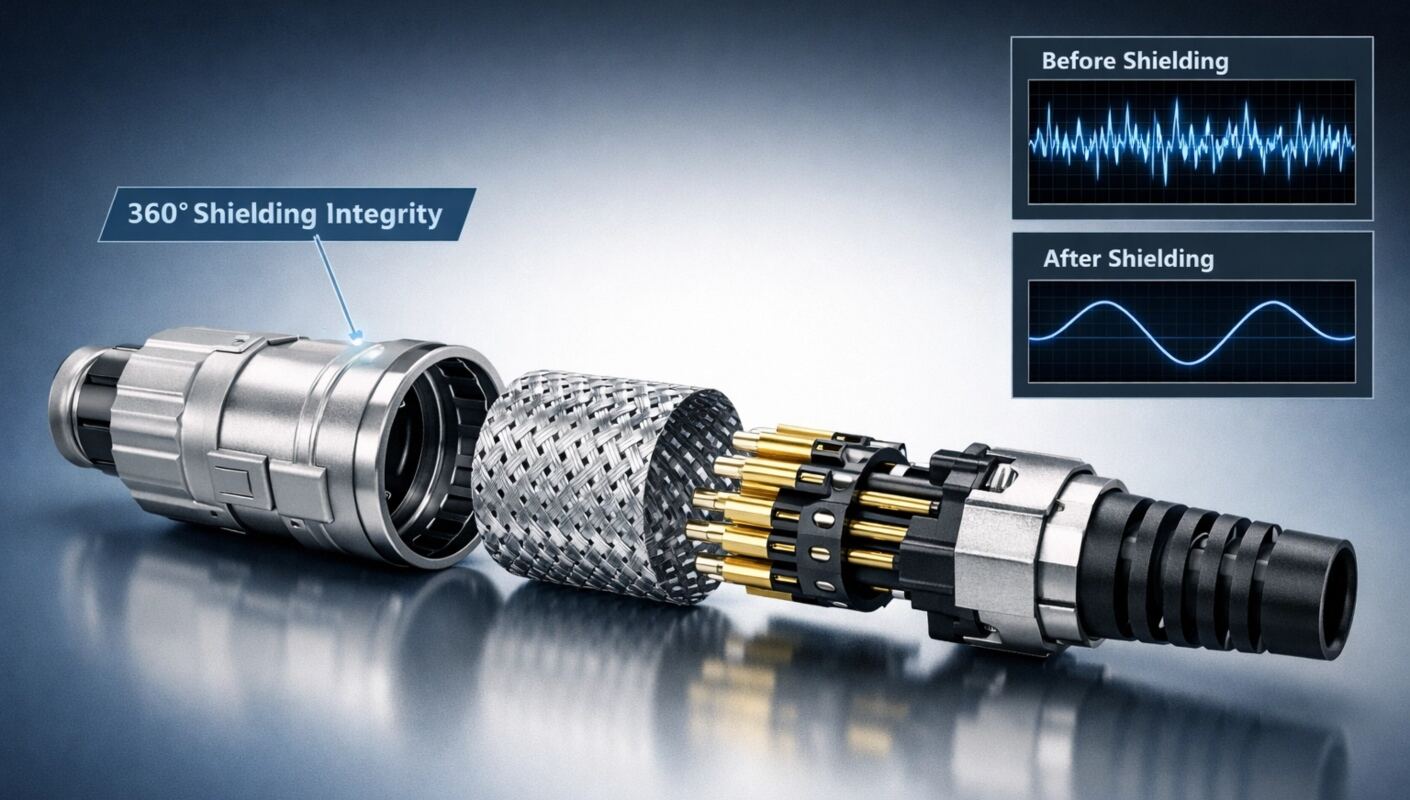
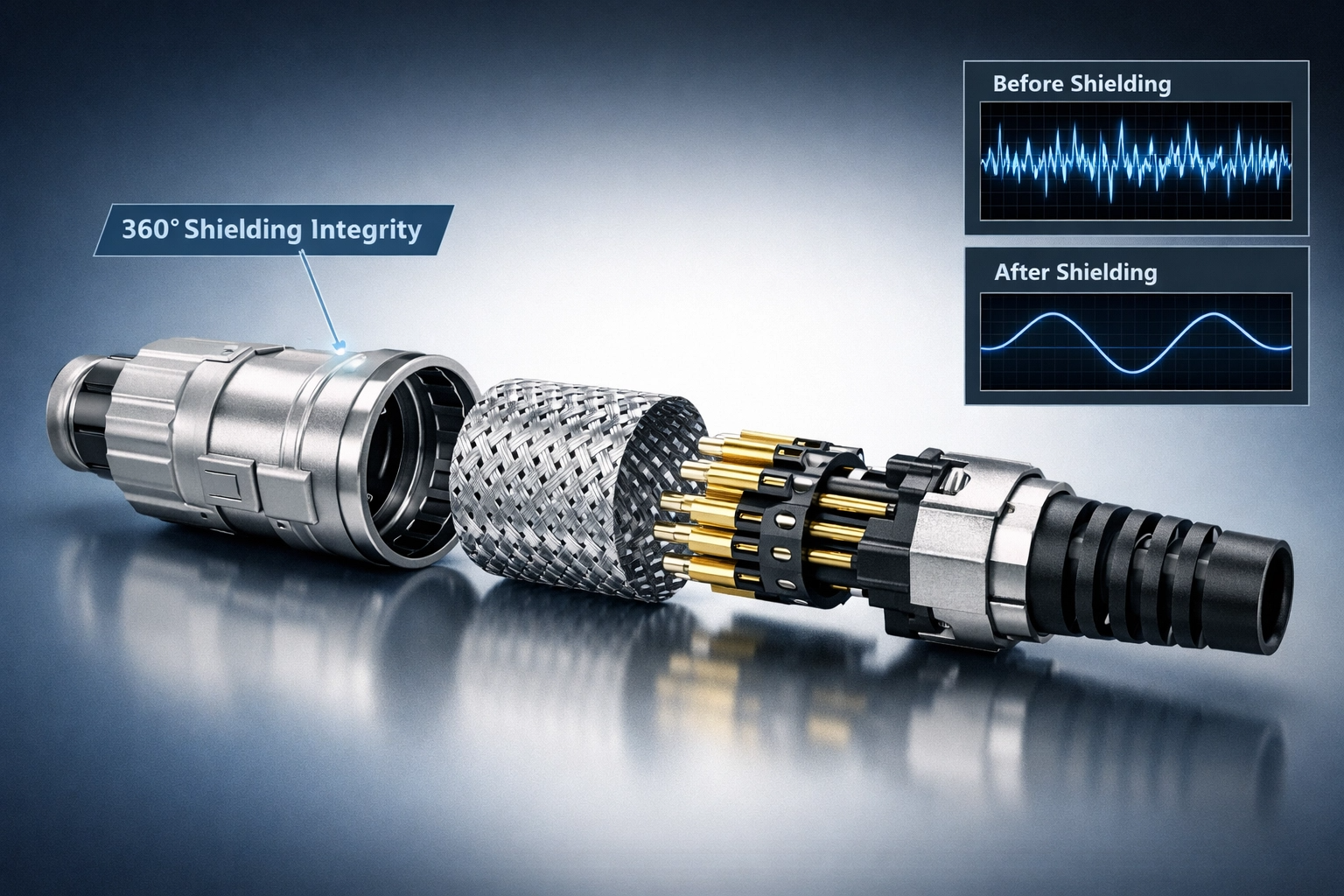
At Chuanshang, when we provide Automation and Controls solutions, we emphasize the physical construction of the interconnect. A truly shielded connector is more than just a metal shell; it is a comprehensive Faraday cage for your data.
360-Degree Shielding Integrity
The most common point of failure in a shielded system is the "shield-to-housing" transition. Many low-quality connectors leave small gaps where the cable shield meets the connector body. These gaps allow high-frequency noise to leak in.
Our high-performance connectors utilize a 360-degree radial compression or specialized conductive gaskets. This ensures that from the tip of the pin to the end of the cable, there is a continuous, unbroken metal barrier protecting the sensitive signals inside.
Material Science: Beyond Standard Plastic
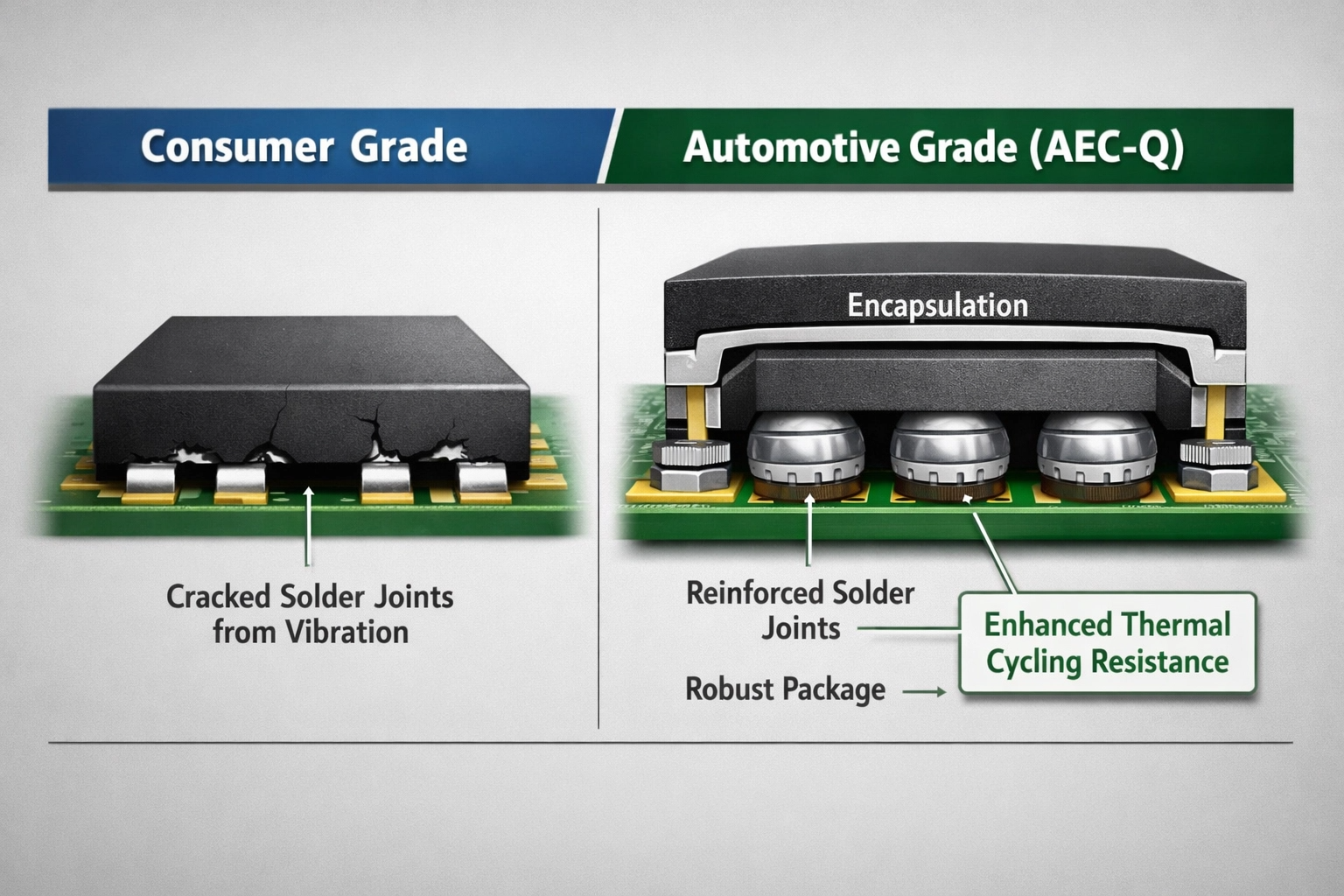
In industrial robotics, the connector housing must be durable. We offer specialized zinc-alloy or nickel-plated brass housings. These materials provide superior "Shielding Effectiveness" compared to conductive-coated plastics, which can flake or degrade over time under the constant mechanical stress of a moving robot joint.
3. Impact on Productivity: The True Cost of "Ghost Failures"
From a procurement perspective, a shielded connector carries a higher initial cost. However, the "cost of failure" in a robotic line is measured in thousands of dollars per minute of downtime.
The Problem with Intermittent Faults
Engineers call EMI-related issues "ghost failures" because they are notoriously difficult to diagnose. A robot might run perfectly for three days and then suddenly error out because a large motor on the other side of the factory started up.
By utilizing Shielded Interconnects from the beginning, manufacturers eliminate the root cause of these intermittent errors. This leads to:
• Higher Throughput: Fewer unexpected halts in production.
• Reduced Troubleshooting: Maintenance teams spend less time chasing phantom signal drops and more time on preventative care.
• Longer Equipment Life: By preventing "noise-induced" voltage spikes from reaching the Integrated Circuits, the sensitive internal electronics last longer.
4. Professional Knowledge: The Role of Passive Components in EMI Suppression
While the connector provides the physical barrier, the internal circuitry needs a second line of defense. This is where Passive Components play a vital role.
Filtering at the Board Level
Even with the best shielded cables, some noise may still reside on the line. In the control modules we support, we recommend the integration of:
• Common Mode Chokes: These components allow the desired signal to pass while blocking the "common mode" noise that EMI creates.
• Ferrite Beads: Acting as high-frequency resistors, they dissipate noise energy as a tiny amount of heat before it reaches the Integrated Circuits.
• Decoupling Capacitors: These act as local energy reservoirs, ensuring that the power supply to the IC remains stable even when the external environment is electrically turbulent.
5. Case Study Insight: Solving Precision Drift in a Multi-Axis System
We recently consulted for a robotic integrator whose units were experiencing a two-millimeter positional drift when operating at peak speeds. The issue was not mechanical; it was electrical. The feedback signals from the rotary encoders were being corrupted by the high-current lines powering the robot's main lift motor.
The Solution:
We replaced the existing unshielded plastic connectors with our Heavy-Duty Shielded Series and added high-frequency bypass capacitors to the sensor interface.
The Result:
The positional drift was eliminated entirely. The "Signal-to-Noise Ratio" improved by over forty percent, allowing the robot to operate at its maximum rated speed with zero communication errors.
6. Industry Analysis: The Move Toward High-Speed Industrial Ethernet
As robotics move toward Industrial Ethernet and real-time protocols like EtherCAT, the frequency of the data signals is increasing. Higher frequencies are even more sensitive to EMI.
At Chuanshang Electronics, we are seeing a shift where shielded connectors are no longer just for "heavy industry" but are becoming the standard for all automation. European and North American safety standards are also becoming stricter regarding Electromagnetic Compatibility (EMC) compliance. Using shielded components is the fastest way for a manufacturer to pass these mandatory regulatory tests.
Conclusion: Investing in Signal Certainty
In the race for automation efficiency, the physical layer—the cables and connectors—is often the most overlooked part of the system. Yet, as we have seen, it is the foundation upon which all robotic precision is built.
Shenzhen Chuanshang Electronics is dedicated to providing the global robotics industry with the robust, shielded, and high-performance components required for the 24/7 factory of the future. By choosing the right Interconnects, ICs, and Passive Components, you are not just buying parts; you are buying the certainty that your robots will perform exactly as programmed, every single time.
Engineering Summary: Shielding Selection Criteria
Factor |
Requirement for Robotics |
Why It Matters |
Housing Material |
Conductive Metal (Zinc/Nickel) |
Provides a durable Faraday cage against external fields. |
Mating Cycles |
High (500 to 1000+) |
Ensures shielding integrity remains after repeated maintenance. |
Vibration Lock |
Positive Locking / Screw-Down |
Prevents shield "breakage" during rapid robotic movement. |
 EN
EN