Introduction: The Threshold of Automotive Reliability
In the global electronics supply chain, the term "Automotive Grade" is often used, but its true technical weight is sometimes misunderstood. For engineers at passenger car manufacturers or Tier 1 suppliers in Europe and North America, this classification is the difference between a vehicle that lasts twenty years and one that fails in its first winter.
At Shenzhen Chuanshang Electronics, we have spent over a decade navigating the rigorous transition from industrial-grade distribution to the high-stakes world of automotive electronics. This article explores the defining characteristics of automotive-grade components, the critical nature of AEC-Q testing, and why IATF 16949 certification is the baseline for any serious automotive partner.
1. Defining the Automotive Grade: More Than Just a Label
When a worker on an assembly line installs a connector or a semiconductor into a Battery Management System, they are trusting that the component can survive environments that would destroy standard consumer electronics.
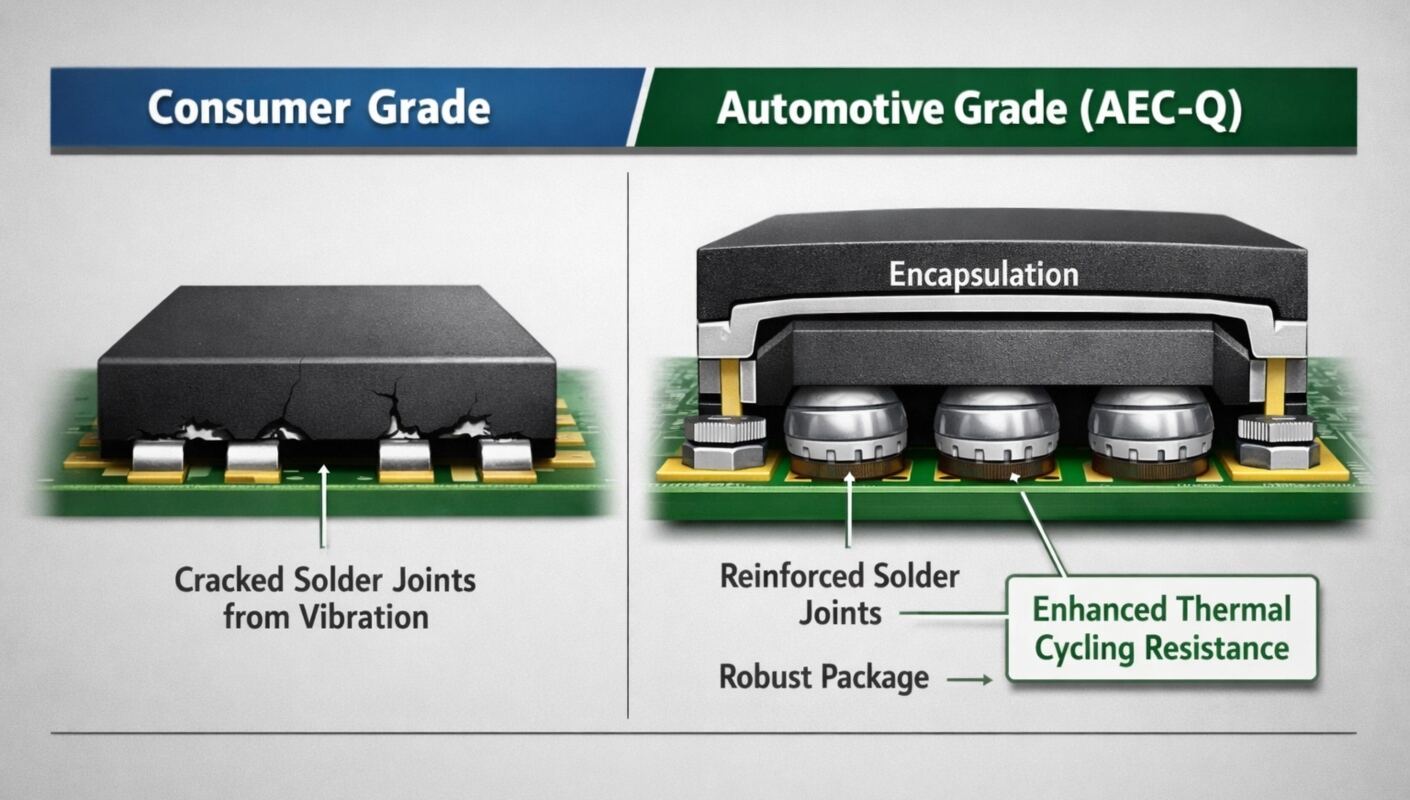
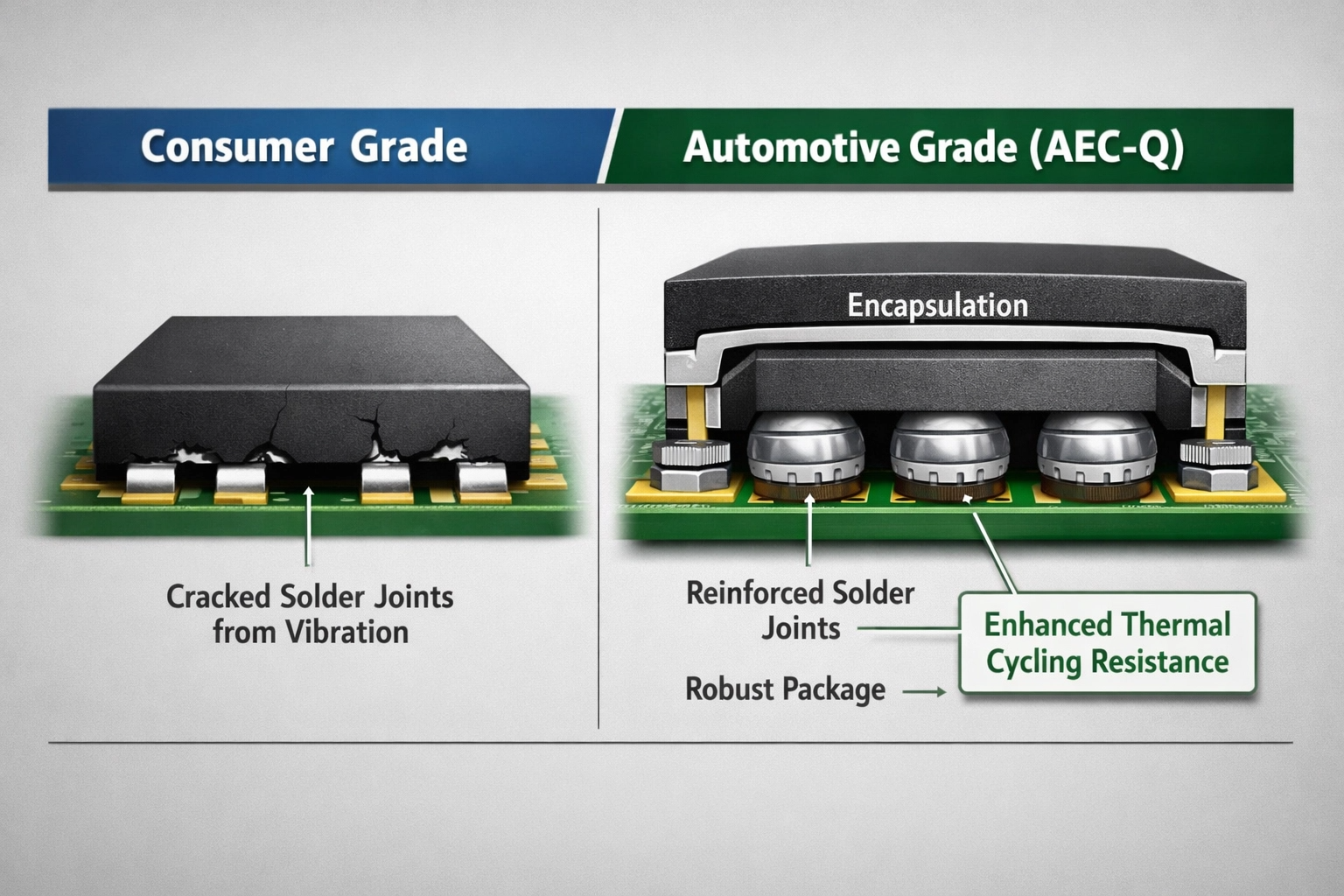
A "Commercial Grade" component is designed for an office or home environment—stable temperatures and low vibration. An "Industrial Grade" component adds a layer of durability for factory floors. However, an "Automotive Grade" component must survive a unique combination of high-speed vibration, chemical exposure (like oil and road salt), and extreme thermal cycling for the entire life of the vehicle.
The Reliability Expectation
The automotive industry operates on a "Zero Defect" philosophy. While a failure in a smartphone is an inconvenience, a failure in a vehicle's braking IC or steering sensor is a life-critical event. Therefore, automotive components are engineered with larger safety margins in their physical structure and electrical performance.
2. The Gold Standard: Understanding the AEC-Q Series
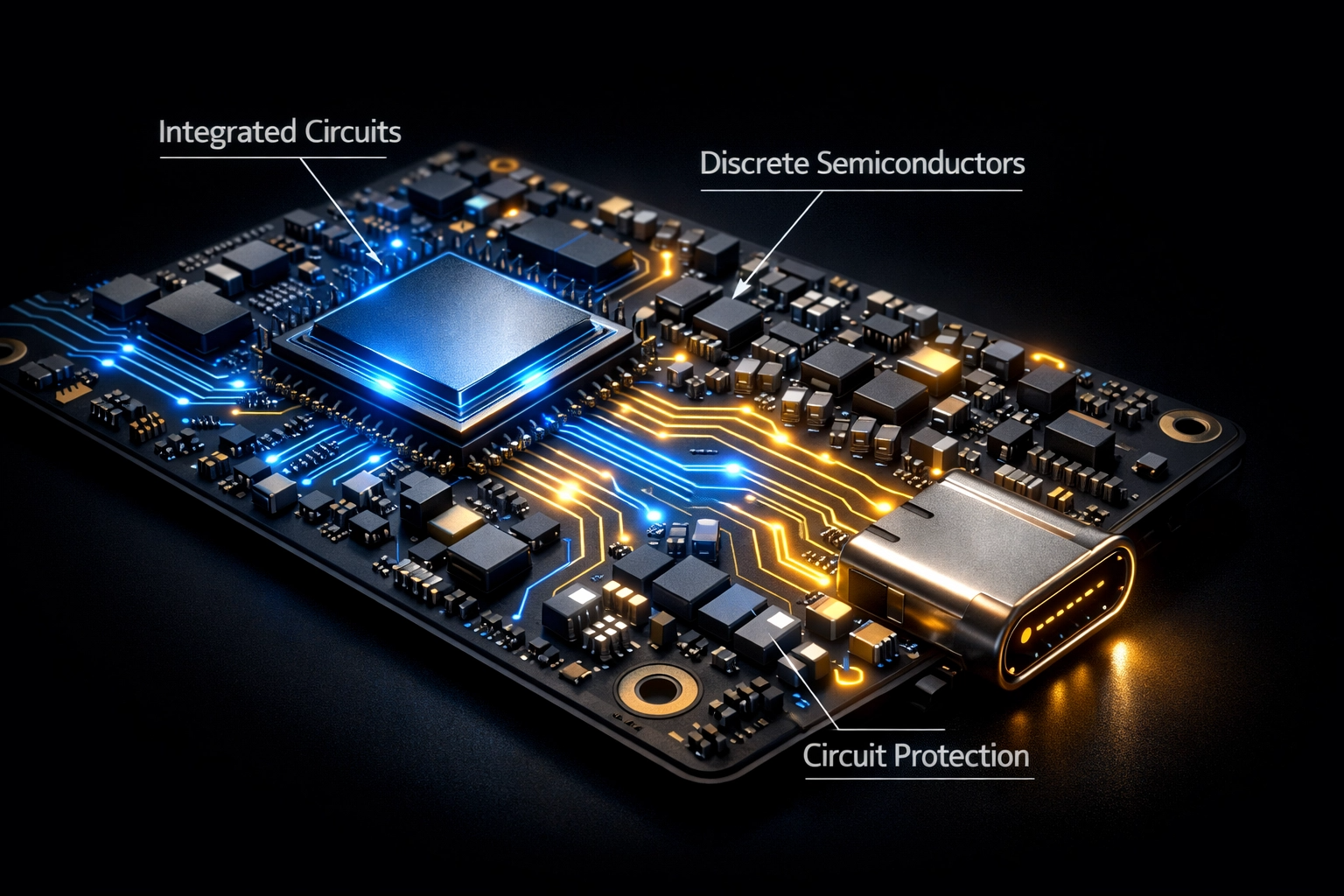
The Automotive Electronics Council (AEC) established the AEC-Q standards to create a universal set of stress tests for components. When Chuanshang Electronics sources Integrated Circuits or Connectors, we verify their compliance against these specific sub-categories:
AEC-Q100: Integrated Circuits (ICs)
This is the most common standard for the "brains" of the car. To pass AEC-Q100, an IC must undergo several stress tests, including:
• High-Temperature Operating Life: Ensuring the chip can function at full load for thousands of hours without internal degradation.
• Early Life Failure Rate: Identifying "infant mortality" in chips before they ever reach the assembly plant.
• Soft Error Rate: Testing how the chip reacts to radiation or electrical noise to prevent logic errors.
For components like MOSFETs and Diodes used in power conversion, AEC-Q101 ensures that the packaging can handle rapid switching and high current without cracking. For example, the lead-frame and bonding wires inside an automotive MOSFET are often thicker and made of more durable alloys than their commercial counterparts.
AEC-Q200: Passive Components
Resistors, Capacitors, and Inductors are the "heartbeat" of the circuit. AEC-Q200 testing involves brutal mechanical shock and humidity bias tests. In our experience, we have seen that AEC-Q200 rated capacitors have significantly lower failure rates in high-vibration environments like the engine bay or the wheel well.
3. The Supply Chain Pillar: IATF 16949 and Quality Management
If AEC-Q is about the product, IATF 16949 is about the process. As a distributor deeply embedded in the automotive market, Chuanshang Electronics aligns with partners who adhere to this International Standard for Automotive Quality Management Systems.
Why Process Control Matters
IATF 16949 requires manufacturers to have a rigorous "Change Management" process. In consumer electronics, a factory might change a sub-supplier for a plastic resin overnight. In the automotive world, such a change requires notification and re-validation. This ensures that the component you buy today is identical in performance to the one you tested two years ago.
For our clients in the Asian and European markets, this traceability is vital. It allows for "root cause analysis" in the rare event of a field failure, tracking a specific component back to its original silicon wafer or raw material batch.
4. Engineering Insight: Thermal Cycling and Mechanical Fatigue
From a technical perspective, the greatest enemy of an automotive component is Coefficient of Thermal Expansion (CTE) Mismatch. Inside a car, parts heat up and cool down thousands of times. If a connector housing expands at a different rate than the metal pins, the resulting stress will eventually crack the solder joints on the PCB.
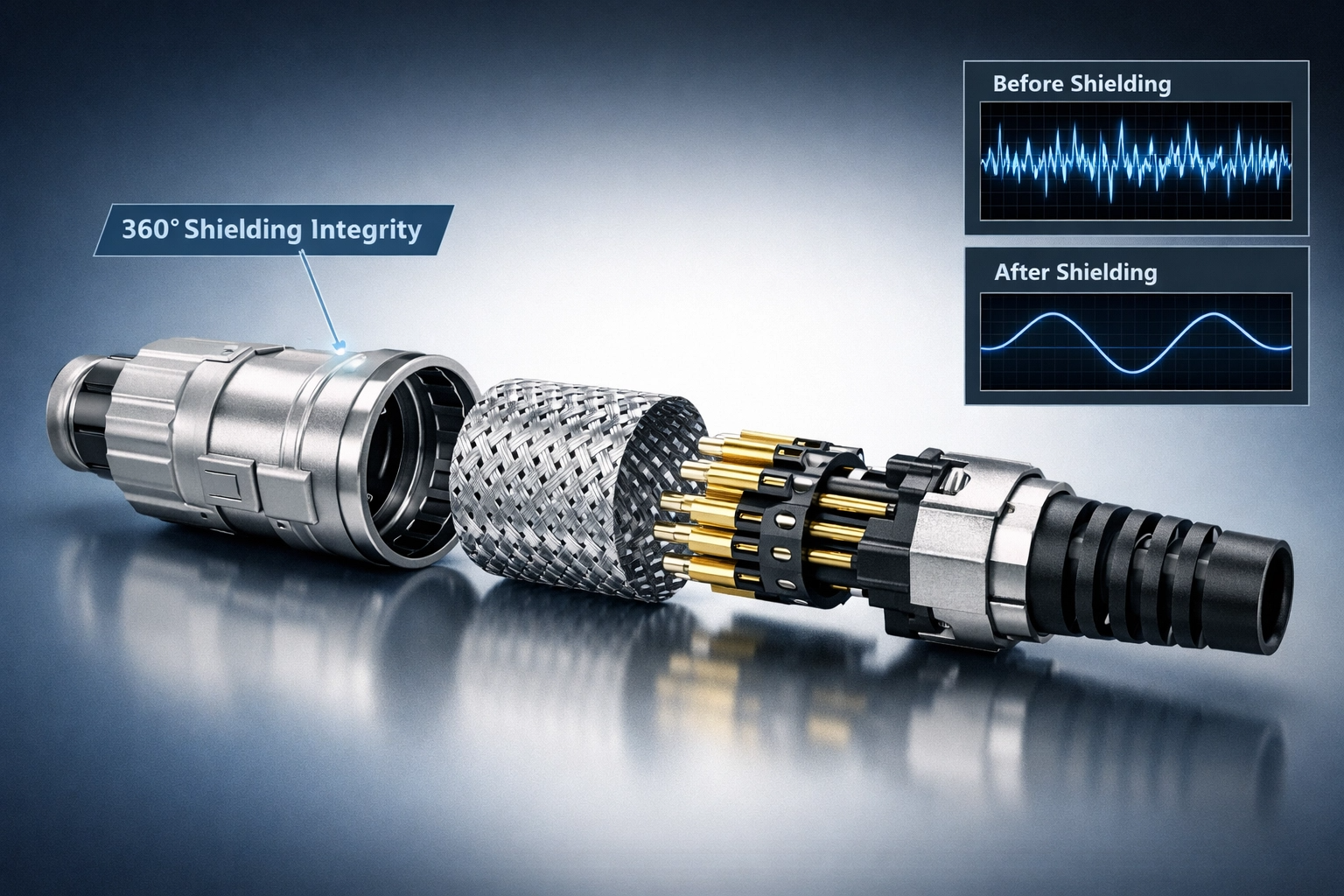
The Chuanshang Approach: We prioritize Interconnects made from Liquid Crystal Polymers and specialized copper alloys that have matched thermal expansion profiles. This "Engineering-First" selection prevents the micro-cracks that lead to intermittent signal loss—a technician's nightmare when trying to diagnose vehicle errors.
5. How to Select the Right Grade for Your Application
Not every part of a vehicle requires the same grade of component. Automotive engineers typically use a tiered system:
Grade 0: The most extreme, for engine-mounted electronics.
Grade 1: Standard for most under-the-hood and powertrain applications.
Grade 2 and 3: Common for in-cabin "Infotainment" or dashboard electronics where the environment is more controlled.
l The Cost of Quality vs. The Cost of Failure
Procurement managers often ask why automotive-grade parts carry a premium price. The answer lies in the Testing Yield. Because the standards are so high, a smaller percentage of manufactured chips make the cut for Grade 0 or Grade 1. However, when you calculate the cost of a single vehicle recall—which can reach into the hundreds of millions of dollars—the investment in a high-quality, AEC-Q certified component from a trusted partner like Chuanshang is the most cost-effective decision.
6. The Role of the Expert Partner in Automotive Design
Navigating the thousands of pages of AEC-Q specifications can be overwhelming for design teams focused on software and system architecture. This is where Shenzhen Chuanshang Electronics adds value.
We don't just provide a part number; we provide the Validation Data. Our technical team assists in:
• Cross-Referencing: Finding automotive-grade alternatives when a specific part faces long lead times.
• Compliance Verification: Ensuring that every datasheet meets the specific temperature and vibration requirements of your vehicle's architecture.
• Future-Proofing: Suggesting newer, more efficient Integrated Circuits that meet upcoming 800-Volt EV standards.
Conclusion: Reliability as a Competitive Advantage
In the modern automotive industry, brand loyalty is built on trust. Consumers expect their vehicles to be safe and dependable in every climate and on every road. By insisting on true Automotive-Grade components and adhering to AEC-Q and IATF 16949 standards, you are building that trust into the very fabric of your product.
At Chuanshang Electronics, we remain committed to being the reliable link in your automotive supply chain. We invite you to consult with our engineering team to ensure your next-generation vehicle is built on a foundation of unshakeable quality.
 EN
EN