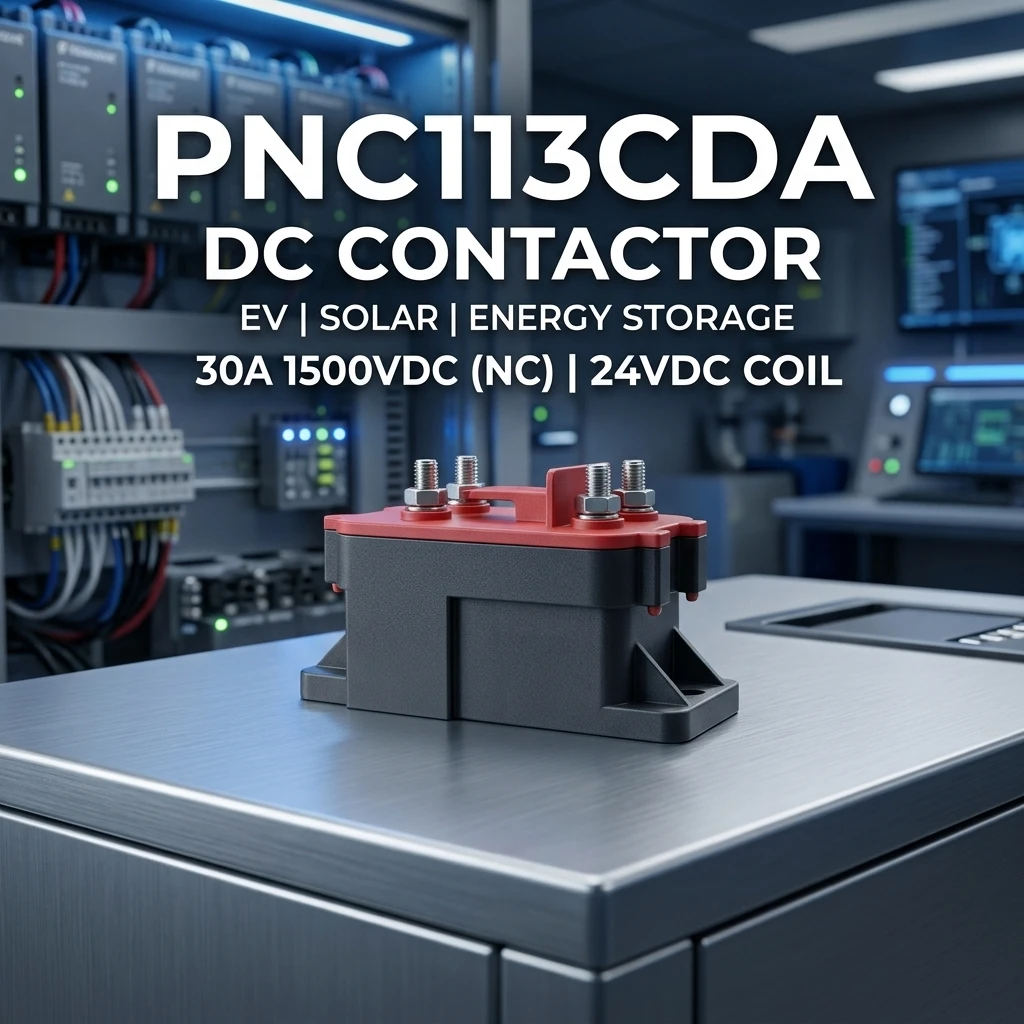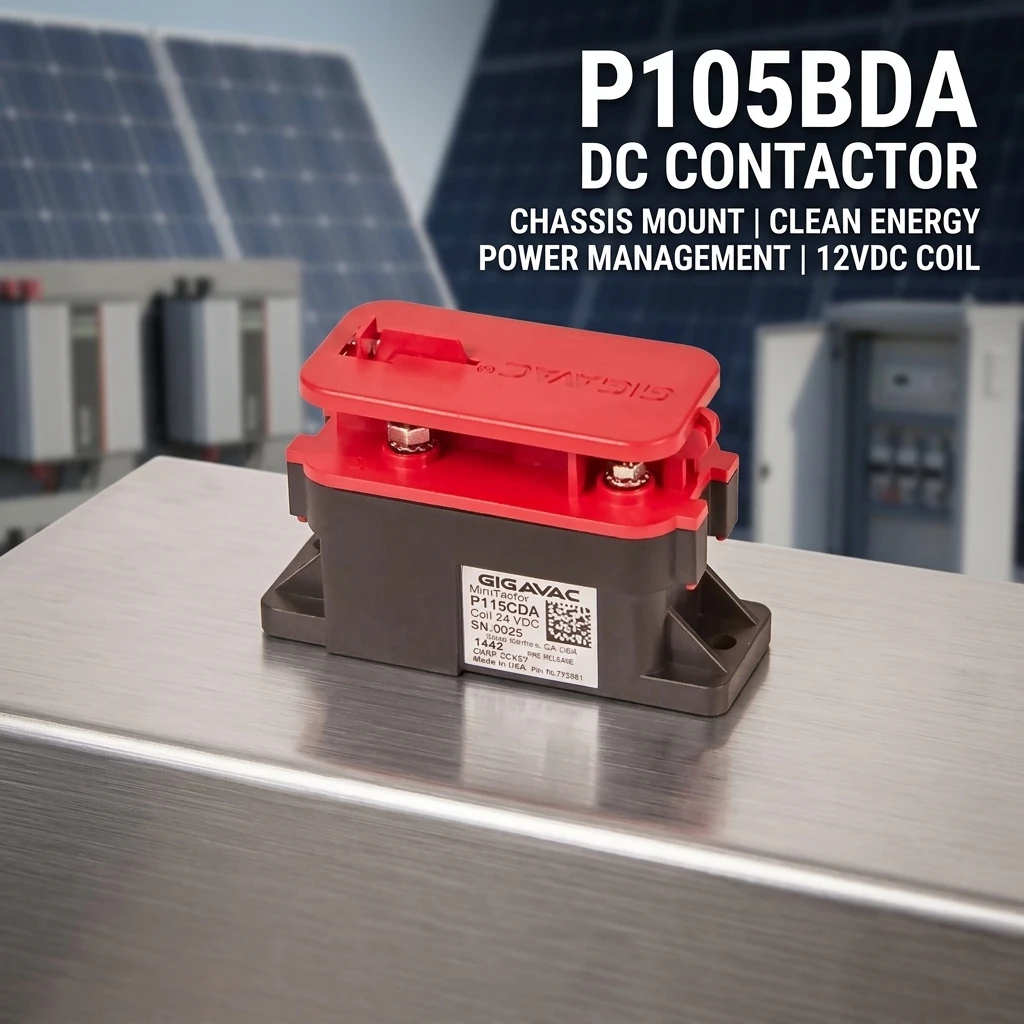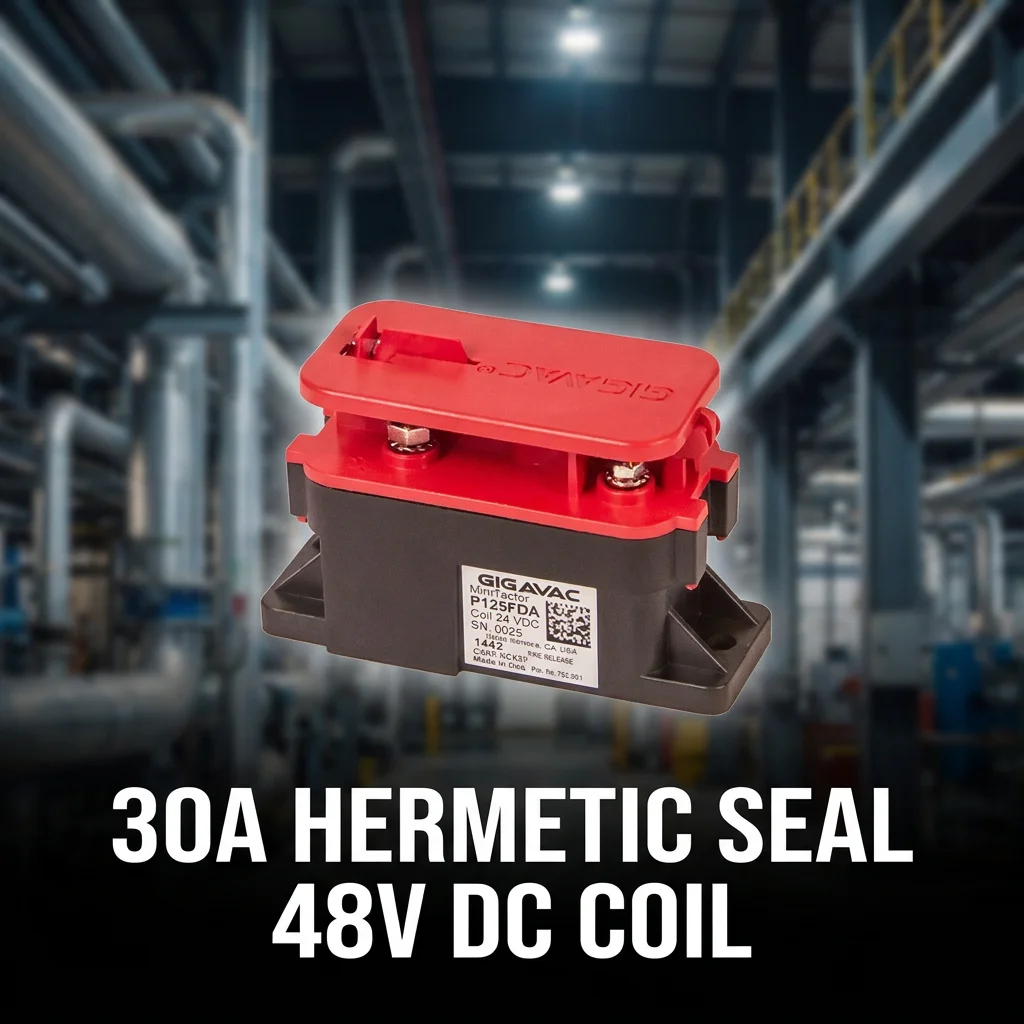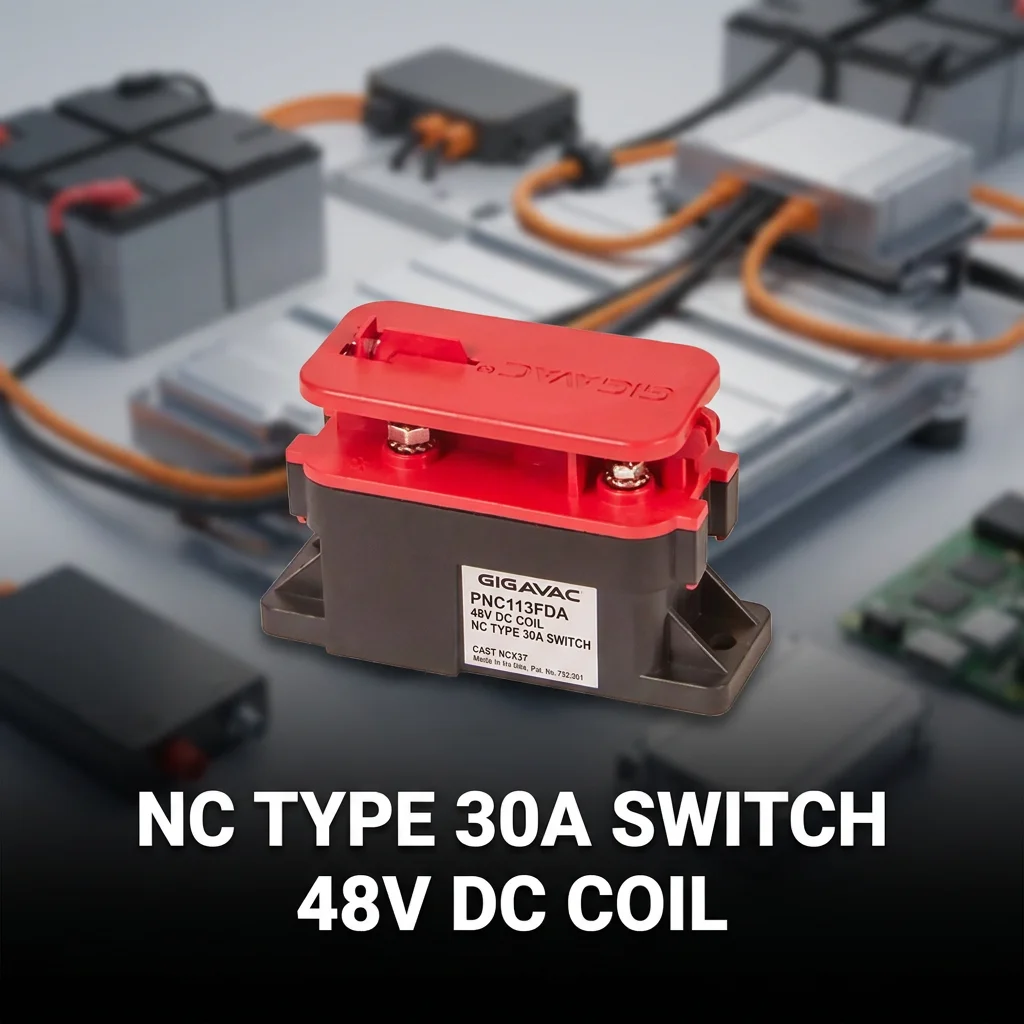
Sensata Gigavac PNC113CDA PNC113 normally closed MiniTACTOR, 30A, 1500VDC switching, 24VDC coil, M3 coil studs, M4 power studs
The Sensata Gigavac PNC113CDA is a PNC113 Series normally closed MiniTACTOR designed for high-voltage DC discharge and dump switch applications. This model is configured with a 30 A current rating, 1500VDC maximum operating voltage, a 24VDC coil, M3 coil studs, M4 power studs, and an SPST-NC main contact. The 1500VDC value refers to the main power/load circuit, while the 24VDC value refers to the coil/control circuit used to change the contact state.
| Category | Relays - Contactors, Electromechanical |
| Manufacturer | Sensata-Gigavac Clean Energy |
| Manufacturer Product Number | PNC113CDA |
| Series | PNC113 MiniTACTOR |
| Product Type | Normally Closed High Voltage DC Contactor |
| Mounting Type | Chassis Mount / Panel Mount |
| Coil Voltage | 24VDC |
| Contact Form | SPST-NC, 1 Form Y Main Contact |
| Contact Rating Current | 30 A at 25°C with 8 AWG conductor |
| Current Rating at 65°C | 15 A with 8 AWG conductor |
| Switching Voltage | 1500VDC Max |
| Termination Style | Stud Terminals |
| Coil Terminals | M3 Studs |
| Power Terminals | M4 Studs |
| Auxiliary Contact | None |
| Operating Temperature | -40°C to +65°C |
| Must Operate Voltage | 15 VDC |
| Must Release Voltage | 0.4 VDC Min |
| Operate Time | 25 ms Max |
| Release Time | 8 ms Max |
| Coil Current | 85 mA at nominal voltage |
| Coil Resistance | 280 Ohms +/-10% |
| Dielectric Withstanding Voltage | 4300 VRMS at sea level |
| Mechanical Life | 100,000 Cycles |
| Typical Weight | Approx. 135 g |
The Sensata Gigavac PNC113CDA is not a standard normally open contactor. It is a normally closed MiniTACTOR for circuits that need the main contact closed when the coil is not energized. In the resting state, the main contact is closed. When the 24VDC coil is energized, the contactor opens the main contact. When coil power is removed, the contact returns to the closed state.
This operating behavior makes PNC113CDA especially useful for capacitor discharge, dump switch, fail-closed discharge, and stored-energy removal applications. In an inverter, energy storage system, test cabinet, or battery-connected HVDC circuit, a normally closed discharge contactor can provide a default current path when control power is removed. The contactor is the switching element; the final discharge current and time depend on the complete circuit, including resistors, fuses, wiring, and thermal design.
The full model number should be used in backend records and product listings. “PNC113” identifies the 30 A normally closed MiniTACTOR family. The “C” indicates the 24VDC coil version. The “D” indicates M3 stud coil terminals. The “A” indicates M4 stud power terminals. This model does not include an auxiliary contact, so system feedback must be handled separately if position monitoring is required.
The Sensata Gigavac PNC113CDA is commonly used in high-voltage DC circuits where the default state must be closed rather than open. Typical applications include capacitor discharge circuits, inverter DC link discharge, battery energy storage safety circuits, photovoltaic power equipment, HVDC test systems, power conversion cabinets, charger discharge circuits, and industrial dump switch systems.
Because the main contact is normally closed, PNC113CDA should be selected only when the electrical design specifically requires this behavior. For example, a system may energize the coil during normal operation to hold the discharge path open. When the system shuts down or loses control power, the contactor releases and closes the discharge path through a designed resistor network.
The 1500VDC and 24VDC ratings describe separate circuits. The 1500VDC rating applies to the main contact/load circuit. The 24VDC rating applies to the coil circuit that changes the contact state. A 24V control output may open the normally closed contactor while the main terminals are connected to a much higher DC voltage, provided the full circuit stays within the contactor ratings.
PNC113CDA does not include built-in auxiliary feedback. If the control system needs confirmation of contactor state, use external sensing or a system-level monitoring method. The coil suppression device is not built into the contactor, so the recommended external suppression for the 24V coil should be considered during control circuit design.
For discharge applications, verify discharge resistor value, peak current, energy rating, time constant, cable size, insulation spacing, temperature rise, and fault behavior. The contactor is rated for 30 A continuous carry at 25°C, but current capability changes with conductor size, ambient temperature, and duty cycle.
PNC113CDA is a strong choice when a compact normally closed contactor is needed for HVDC discharge functions. Compared with larger high-current contactors, it provides a smaller and lighter solution for 30 A circuits. Compared with normally open P Series MiniTACTOR models, PNC113CDA provides the opposite default state, which is essential for fail-closed discharge and dump switch designs.
For backend product listings, write the full name as Sensata Gigavac PNC113CDA. Avoid shortening it to PNC113 only, because related models can use 12VDC, 24VDC, or 48VDC coils. PNC113CDA specifically identifies the 24VDC coil, M3 coil stud, M4 power stud version.
Is PNC113CDA normally open or normally closed?
PNC113CDA is normally closed. The main contact is SPST-NC, also described as 1 Form Y.
Is PNC113CDA a 1500V or 24V contactor?
It uses both values for different circuits. The main contact is rated up to 1500VDC, while the coil/control circuit is 24VDC.
Does PNC113CDA have an auxiliary contact?
No. This model does not include an auxiliary contact.
What is PNC113CDA used for?
It is mainly used for capacitor discharge, dump switch, and fail-closed high-voltage DC circuits.
Sensata Gigavac PNC113CDA PNC113 normally closed MiniTACTOR, 30A, 1500VDC switching, 24VDC coil, M3 coil studs, M4 power studs
Explore premium ICs, sensors, and power controls to support your advanced technical requirements.