Introduction: The Heart of the Automated Factory
In the vast landscape of modern manufacturing, the industrial control cabinet serves as the nerve center. Whether it is managing a food processing line in Europe or an automotive assembly plant in North America, these units must operate with zero downtime. For the electrical technicians and system integrators who build these cabinets, the selection of internal components is a balance between space efficiency and long-term thermal stability.
At Shenzhen Chuanshang Electronics, we recognize that "Industrial Grade" is a standard defined by endurance. A control unit is only as strong as its weakest resistor or most vulnerable connector. This article breaks down the critical selection criteria for Automation and Controls, Discrete Semiconductors, and Passive Components that form the foundation of a resilient automation system.
1. Power Quality and Distribution: The Foundation of Reliability
Every automated system begins with power. In an industrial environment, the incoming power is rarely clean. It is often plagued by voltage surges, harmonics, and high-frequency noise from neighboring heavy machinery.
• Robust Discrete Semiconductors for Power Conversion
The first stage of any control unit is the power supply module. Here, Discrete Semiconductors such as power diodes and MOSFETs must handle significant current loads without excessive heat generation. We prioritize components with low thermal resistance, allowing for more compact heat sink designs. By selecting semiconductors with a high breakdown voltage margin, we ensure that the system can survive the transient voltage spikes common in heavy-industrial power grids.
• The Role of High-End Passive Components
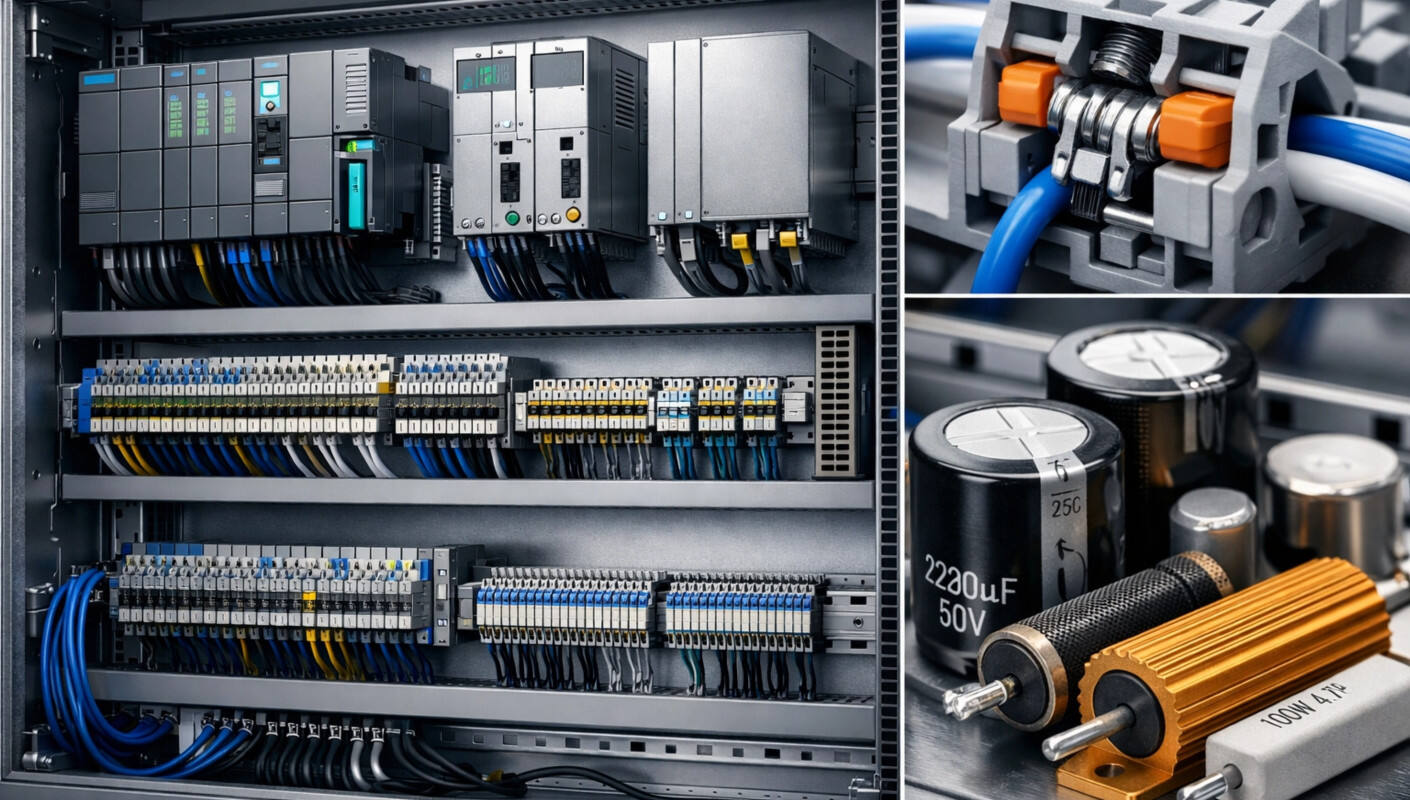
To smooth out the rectified power, large aluminum electrolytic capacitors are employed. However, in a sealed control cabinet, internal ambient temperatures can rise significantly. Standard capacitors may dry out over time, leading to a loss of capacitance and eventual system ripple.
The Chuanshang Standard: We supply Passive Components specifically rated for extended life in high-temperature environments. By focusing on components with high ripple-current ratings and low equivalent series resistance, we help manufacturers extend the Mean Time Between Failures for their power stages.
2. Signal Integrity in the Logic and Input/Output Layer
Once stable power is established, the "brain" of the system—the Programmable Logic Controller (PLC) or Industrial PC—must communicate with field devices like valves, motors, and sensors.
• High-Density Interconnect Solutions
As control cabinets become more crowded, space-saving becomes a priority. Our Automation and Controls interconnect line features high-density, rail-mounted terminal blocks and board-to-wire connectors.
Vibration Resistance: In factories with heavy stamping or milling machines, mechanical vibration is constant. We recommend connectors with spring-cage or "push-in" technology. Unlike traditional screw terminals, which can loosen over time due to vibration, these tension-based systems maintain a constant contact force, ensuring a permanent and maintenance-free connection.
• Integrated Circuits for Precision Signal Processing
The analog signals coming from the factory floor—such as pressure or flow data—are often weak and susceptible to noise. The Integrated Circuits used for signal conditioning and isolation must have high precision and excellent common-mode rejection. We provide isolation amplifiers and high-speed optocouplers that create a "galvanic barrier," protecting the expensive central processor from high-voltage surges on the field-side wiring.
3. System-Level Protection: Ensuring Operational Continuity
A single lightning strike or a short circuit in a field motor should not take down an entire production line. This is where a multi-layered Circuit Protection strategy is vital.
• Defending the Communication Bus
Industrial protocols like CAN-bus or Industrial Ethernet are the lifeblood of automation. We integrate specialized Transient Voltage Suppressor (TVS) arrays and ESD protection chips at every communication port. These components are designed to "clamp" over-voltages in less than a nanosecond, diverting the energy safely to the ground before it can reach the sensitive communication Integrated Circuits.
• Over-Current and Thermal Protection
Beyond electrical protection, mechanical protection is equally important. Our Circuit Protection portfolio includes resettable fuses and thermal cut-off devices. For a technician on the factory floor, a resettable fuse is a massive time-saver. Instead of hunting for a replacement glass fuse in a dark cabinet, the system can be reset once the fault is cleared, minimizing expensive downtime.
4. Professional Knowledge Supply: Understanding Ingress Protection and Thermal Management
For the engineers designing these systems, two factors often dictate the lifespan of the electronics: Ingress Protection (IP) and Heat Dissipation.
• The IP Rating Paradox
A higher IP rating (such as IP65 or IP66) means the cabinet is better sealed against dust and moisture. However, a better seal also traps more heat.
Engineering Tip: When selecting Embedded Solutions for a high-IP enclosure, it is critical to calculate the "thermal budget." We suggest using components with lower power consumption profiles. For example, replacing older linear regulators with modern high-efficiency switching regulators can reduce the internal heat load by as much as thirty percent, significantly extending the life of all nearby electronics.
• Component Spacing and Airflow
Even with high-efficiency parts, the physical layout matters. We advise our clients to place heat-generating Discrete Semiconductors at the top of the board or near ventilation paths, while keeping sensitive Passive Components like timing capacitors in the cooler zones. This "thermal-aware" design approach is a hallmark of high-end industrial engineering.
5.Industry Analysis: The Transition to Decentralized Control
The global trend in automation is moving away from one giant central cabinet toward "Decentralized I/O." In this model, smaller control boxes are placed directly on the machinery.
Smaller, Smarter, and Tougher
This shift requires components to be even more rugged. Embedded Solutions must now be able to withstand direct exposure to industrial fluids and higher localized vibrations. Chuanshang is supporting this transition by providing miniaturized, fully-potted modules that combine Sensors, ICs, and Connectors into a single, ruggedized unit. This not only saves space but also simplifies the wiring process for the assembly workers, reducing the potential for human error during installation.
Conclusion: Building for the Long Haul
Industrial automation is an investment in the future. At Shenzhen Chuanshang Electronics, we believe that this investment should be protected by the highest quality components available. From the power entry to the final output connector, every part we supply is chosen for its ability to perform in the "real world" of grease, heat, and electrical noise.
By combining deep technical expertise in Integrated Circuits and Discrete Semiconductors with a wide range of Automation and Control hardware, we provide the building blocks for the next generation of global manufacturing.
 EN
EN